Região Centro-oeste (in purple/roxo)

Mato Grosso (Eduardo)
It is the third-largest state by area, located in the western part of the country. In 1977, the state was split into two halves, Mato Gross do Sul being organized as a new state. The Bororo Indians live in the Mato Grosso area. As late as 1880, soldiers patrolled lands on the outskirts of Cuiabá, Mato Grosso's capital and largest city, to protect settlers from Bororo raids.
By the end of the 19th century, although severely reduced by disease and by warfare with explorers, slave traders, prospectors, settlers, and other indigenous groups, as many as five to ten thousand Bororo continued to occupy central and eastern Mato Grosso, as well as western Goiás.The southwestern part of this state was ceded by Brazil to Bolivia in exchange for Acre, according to the Treaty of Petrópolis in 1903.
Mato Grosso had a high rate of population growth in the 20th century due
to timber, ranching and agricultural development. The state as a whole
still has one of the lowest population densities of any Brazilian state. Ethnically, the state includes a relatively high proportion of caboclos (persons of mixed European and Indian ancestry), as do other areas of interior Brazil.
Agriculture is the largest component of GDP at 40.8%, followed by the service sector at 40.2%. The industrial sector represents 19% of GDP (2004). Mato Grosso exports: soybeans 83%, wood 5.6%, meats 4.8%, and cotton 3.3% as of 2002. The state's share of the Brazilian economy is 1.8% as of 2014.
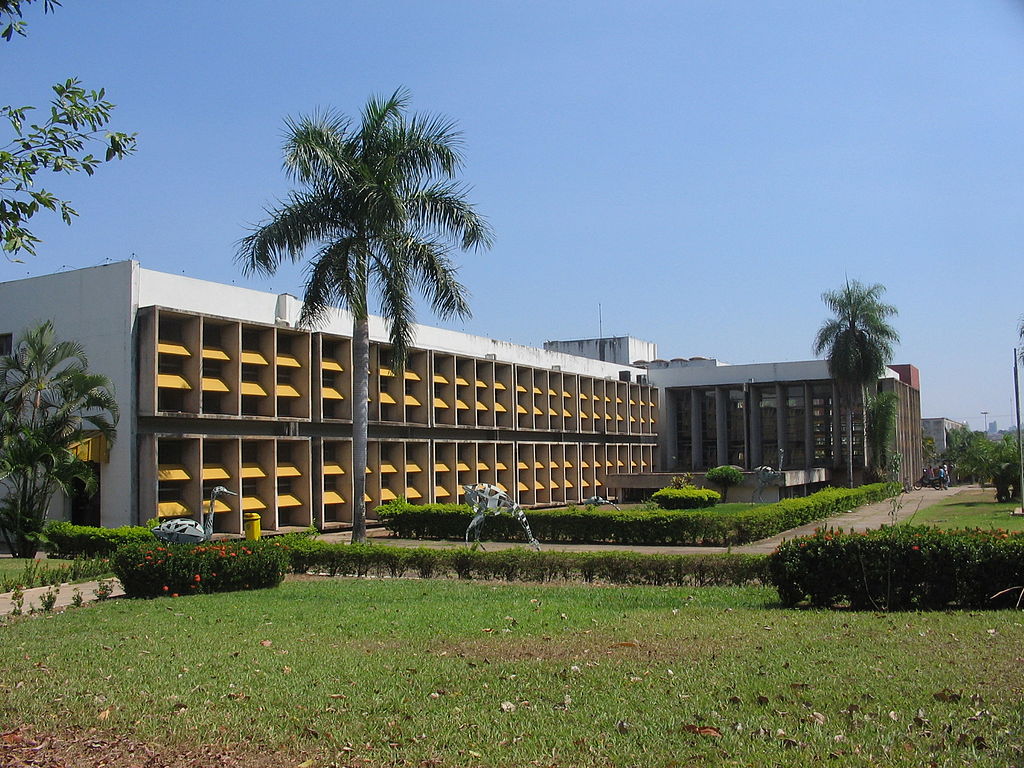 |
Federal University of Mato Grosso in Cuibá |
Portuguese is the official national language, as well as the primary language taught in schools. However, English and Spanish are part of the official high school curriculum. There are more than 58 Universities located in the state of Mato Grosso.
Culture, Tourism & Recreation
The local culture is very rich, due to the influences of and encounters with various cultures, such as indigenous peoples, colonial Spanish and other European settlers, Africans enslaved and transported there in the Atlantic slave trade, originally by the Portuguese, and other Europeans; and immigrants and settlers since the late 19th century. Dance and music were traditionally connected to the worship of Catholic saints and their festivals, Saint Benedict (the city's patron), being one of the favorite.
Carnival
The four-day period before Lent leading up to Ash Wednesday, known as Carnival is well celebrated. As with every state in Brazil, Mato Grosso celebrates this holiday in a typical fashion - including parades, music, and dance - with wide participation.
Alta Floresta
Fishing in the Teles Pires, São Benedito and Azul rivers is productive practically all year long.Bird watching: with the more than 570 species of catalogued birds and new species being discovered every year, the region of Alta Floresta, Cristalino and Azul River Basin receives constant visits from famous ornithologists and bird watchers.
Chapada dos Guimarães
The largest sandstone cavern in Brazil, Aroe Jari, extends nearly 1,550 meters and several prehistoric inscriptions can be found inside.

Águas Quentes State Park
The 1,487 hectares (3,670 acres) Águas Quentes State Park, the first protected area in Mato Grosso, is known for the healing powers of its thermal waters.
Lagoa Azul State Park
The Gruta da Lagoa Azul State Park (Portuguese: Parque Estadual Gruta da Lagoa Azul)
is a state park in the state of Mato Grosso, Brazil. Its primary
attraction is a limestone cave with a pool of blue water and unusual
cave formations. The main threat comes from damage by tourists and local agriculture.The cave has a very fragile ecosystem, dependent on constant temperature and humidity. Increased CO2 from the visitors' breath and heat from their lights can encourage fungus and lichens to attack the speleothems.

 |
| Andorinha Waterfall |
 |
| Pantanal in Mato Grosso |
https://www.brazil.org.za/mato-grosso.html
https://en.wikipedia.org/wiki/Mato_Grosso
Goiás
Brasília (Distrito Federal)
Brasília (Distrito
Federal) -- Brittany Blesener
Brasilia,
capital of Brazil, was founded in 1956 when the president, Juscelino Kubitschek
ordered that the capital move from Rio de Janeiro to a more centralized part in
the country. The federal district region is located in Brasilia, which is the
administrative region and home to the three branches of government, executive,
legislative, and judicial, similar to our Washington DC. The federal district
is considered the “architectural gem” (Wikipedia, 2018) of South America. Because
of this, the United Nations Educational, Scientific and Cultural Organization
actually named it as the World Heritage Site. Oscar Niemeyer was the lead
architect and the man responsible for most of the civic buildings in Brasília
and is considered a key figure in the development of modern architecture. This
modernist theme is shown in all of the government buildings below.

Executive Branch
Headquarters

National Congress Building

Supreme Court of Justice

Supreme Federal Court
Building
The
Praça dos Três Poderes is a square in Brasília where the three branches of
government are found in a triangle-like layout, the Palacio do Planalto, which
is the presidential office, the Congresso Nacional, which is the legislative
branch, and then the Supremo Tribunal Federal which is the supreme federal
court.
As
far as the music goes, Brasília is home of Brazilian rock and hosts the Rock
Basement Festival, helping new bands launch to the national rock scene. Below
is a video link from Raimundos, a brazilian rock band originating from Brasília.
References
“Brasília.” Wikipedia, Wikimedia Foundation, 11
June 2018, en.wikipedia.org/wiki/Brasília.
Meyer, Amelia. “Brazil.org.za.” Distrito Federal, 2010, https://www.brazil.org.za/distrito-federal.html
“Natural Heritage in Brazil | United
Nations Educational, Scientific and Cultural Organization.” UNESCO, Discovery Channel, Producer., www.unesco.org/new/en/brasilia/natural-sciences/environment/natural-heritage/.
“Raimundos - Lugar Ao Sol (DVD Acústico) [Vídeo
Oficial].” YouTube, 21 Nov. 2017, youtu.be/pufRQb6skNM.
Tollerson, Cos. “Modern Latin
America.” Brown's University Library ,
library.brown.edu/create/modernlatinamerica/chapters/chapter-11-brazil/moments-in-brazilian-history-2/brasilia-constructing-a-modern-identity/.


Facts:
* 6th Largest State by Area.
* Area: 137,887 square miles
* Population (2010): 2,449,024
* South Western/ Central State of Brazil
* North West and West of Parana, Sao Paulo, Goias, Minas Gerais
* South of Mato Grosso
* East of Bolivia and Paraguay
* Capital: Campo Grande
* Meaning: Thick Brushes of the South
* Official Language: Portuguese
* $1 U.S Dollar = 3.72 Brazilian Reals
* 1 Brazilian Real = $0.27 U.S Dollars/Cents

In 1979 Mato Grosso Do Sul became its own state after separating from its mother state Mato Grosso. There are Roughly 48 Cities and Towns within the State including Tres Largos, Ponta Pora, Coxim, Bonito, and Corumba.Population is mainly Urban with its people to be of European and Indian Ancestry also known as Mestizo."
Public Health and welfare services are limited in the growing cities despite improving social conditions and improving development. "Despite Continuing, Political and Financial difficulties, since its formation, one of the most solid areas of social economic development in Brazil"-- (Mato Grosso do Sul. (2018). Britannica Online Academic Edition, Encyclopedia Britannica, Inc.). Iron Ore and Manganese are part of a Active Mining industry that help boost that economic industry. This State is home to the Top producing Cattle Livestock Raising in all of Brazil. It is also known to raise Corn, soy beans, wheat Sugarcane and Peanuts.
"The Paraguay drainage is essentially an alluvial flood plan that ranks as one of the worlds best tropical grazing lands known as the Pantanal. Seasonally Flooding makes it one of the worlds largest fresh water wetlands extending into Mato Grosso."

The lack of schools and teachers shadows the quality of an education, though an elementary education is free
In High School, English and Spanish are taught as part of the Curriculum.
A University Education is just like one out here in the states. There are over 44 different universities. It ranks #161-171 amongst Latin American Universities. Universidade Católica Dom Bosco as an example and the most well known,
Universidade Federal de Mato Grosso Do Sul

The Federal University as mentioned above has multiple campus through out the State but the main campus (pictured above) is located in the Capital. All campuses offer various concentrations or majors of study like Science, Medicine and Health, Engineering, Science and Technology to name a few of the popular ones. Just Like ASU the school offers tuition assistance like Financial Aide, Programs and Scholarships. "Science with no Boundaries" is a program that aims to promote consolidation expansion, internationalization of science and technology. Innovation and Brazilian competitiveness through international exchange and mobility. One scholarship program they offer is called the "promises Scholarship" which enhances technical, scientific and cultural cooperation between Brazil and other Countries. the Scholarship provides $622 Reals in aide ($167 dollars)

Fun Facts about the Federal University: Registration cost 150 Reals ($40 U.S) . Diploma Registration cost 130 Reals ($40 U.S). Cafeteria Breakfast cost 3.90 Reals or 1.00 Reals for registered students ($1.05 and $0.27 U.S) . Cafeteria Lunch cost 10.45 Reals or 2.50 Reals for Registered Students ($2.81 and $0.61 U.S)

A Flight from Los Angeles to Mato Grosso Do Sul would take 19 hours and cost $1,500 per person for a round trip fare. You can fine a modest Hotel surrounding and outskirts of the capital for under $50 a night and a Hotel similar to a Hilton or Best Western in the Heart of Downtown with Breakfast included for $70 a night. Due to the equator, Our Winter(Late December to Mid March) is their Summer. Our Spring(Late March to Late June) is their Fall. Our Summer(Late June to Mid September) is their Winter and Our Fall( Late September to Late December) is their Spring.

The Dry period for Mato Grosso Do Sul is from May-September, which would be their Autumn and Winter Season. Through out the year the Average Temperature is 79 Degrees Fahrenheit. The Highlands are much Drier then the Lowlands but the Average Rainfall is 50-60 inches. To give you a precipitation, This year thus far in Los Angeles we have had 4.79 inches of rainfall. in Phoenix the average rainfall is 8 inches.


A Great time to visit Mato Grosso Do Sul would be during the month of May where Campo Grande and Bonito have an event called Brazil Sabor where a Gastronomy Festival with Restaurants preparing special dishes that highlight local ingredients. Another Great time to visit would be during July or August to visit "Festival de Inverno de Bonito"( Bonitos Winter Festival) featuring Art, Music, Theater and Dance. There is sure to be a place for all kinds of travel enthusiasts. Want to visit a Brazilian Urban City? then The capital Campo Grande is for you. Festivals, Eco tourism Hub with Clear water rivers, Waterfalls,expansive caves and Forest trails more your thing then Bonito, Brazil if your go-to. Or How about something more calming like a smaller Southwestern City and Wetlands then look no further then Corumba, Brazil.
References/ Citations:
“Mato Grosso Do Sul.” 2018.
Mato Grosso do Sul. (2018). Britannica Online Academic Edition, Encyclopædia Britannica, Inc.
“Universidade Federal De Mato Grosso Do Sul.” Top Universities, 29 Mar. 2018, www.topuniversities.com/universities/universidade-federal-de-mato-grosso-do-sul.
“Universidade Federal De Mato Grosso Do Sul.” UFMS, www.ufms.br/en/.
Google, Google, www.google.com/search?client=firefox-b-1%2Ccurrency%2Bexchange.
“5-Day Weather Forecast for Campo Grande, Brazil - The Weather Channel.” The Weather Channel, The Weather Channel, 13 June 2018, weather.com/weather/5day/l/BRXX0051:1:BR.
“Time Zone in Campo Grande, Mato Grosso Do Sul, Brazil.” Timeanddate.com, www.timeanddate.com/time/zone/brazil/campo-grande.
“2017-2018 Seasonal Rainfall to Date (Precipitation) Downtown Los Angeles.” Los Angeles Lakers in NBA Basketball Championship Finals, www.laalmanac.com/weather/we13a.php.
“Mato Grosso Do Sul.” Wikipedia, Wikimedia Foundation, 10 June 2018, en.wikipedia.org/wiki/Mato_Grosso_do_Sul.
Oi Eduardo,
ReplyDeleteI enjoyed reading your blog post about Mato Grosso! I found it interesting that the state was split into two halves and that a large portion of the population has Indian and European ancestry. I have always wanted to attend the Carnival celebration and I hope that one day I will be able to! The parades, music and costumes are full of bright colors and life which makes this holiday beautiful and fun! Another place I would love to visit is the healing waters of Aguas Quentes state park. I am interested in investigating this further to understand more about what these healing powers are. Obrigado!
What diversity in Brazil - from the wilds of the rain forests, rivers, and national parks to the lines of the architecture in the major cities! I love looking at the photos in particular. I'm not into the architecture but I loved the looks of the government buildings in Brasiliera.
ReplyDeleteOi Brittany,
ReplyDeleteI enjoyed reading your wonderful post about Brasília! Its interesting that the layout of this political state is similar to the state of Washington DC with the different branches of government occupying the land. By the photos you posted, I can understand how the federal district is known as the “architectural gem” considering the buildings reflect different and unique elements of modern architecture. Thank you for sharing about Brasilia, I hope to visit there sometime soon…obrigado!
Oi Eduardo, Mato Grosso is unique to South America because it is so close to the equator and it is located right in the middle of the continent without cooling effects from ocean currents or breezes. These factors would explain why it is the hottest state in Brazil and how it can sustain places like Aguas Quentches and the environment at Lagoa Azul. The blueness of the water at Lagoa Azul State Park is spectacular and I am curious what makes the water that color. The hot and consistent temperatures provide a paradise for many species of plants, birds and other creatures. Slavery and the conquering of the land by Europeans in the area are common themes for South America it seems, and Mato Grosso was no exception. It's good to know that education has become important with the great number of universities there, and the people have a sense of community through their food, dance, festivities and religion. Great information! Super post.
ReplyDeleteOlá Brittany, Brasília DF is heaven for the photographer and for political and music enthusiasts alike. The architecture is some of the most unique and the most beautiful of any place I have seen (or seen pictures of). The lines and designs are striking. Architect Oscar Niemeyer is a genius. It is interesting that the capitol moved from RDJ to Brasília since a more central location was preferable. Even thought their government is structured similarly to that of the USA, our capitol lies near the coast. This makes me wonder if Washington DC is more vulnerable due to its location. The music scene in Brasília has something to offer for most anyone's taste. I am familiar with a few metal bands from that area, specifically Sepultura and Krisiun. My husband loves this type of music (known as "death metal"), but I really liked the music video from Raimundos that you posted. I learned a lot about this state from your blog. Wonderful photos as well. Thank you!
ReplyDeleteOi Eduardo,
ReplyDeleteI really enjoyed your post about Mato Grosso. The pictures you posted were absolutely beautiful. I recently went on a nature ride in Savannah Georgia and did some bird watching on a national wildlife preserve so I would love to see all of the beautiful birds and wildlife at Alta Floresta.
Oi Brittany,
ReplyDeleteIt was really interesting to see the wonderful architectural work of Oscar Niemeyer. While reading your blog I thought I recognized the name so I looked up more of his works. They are absolutely stunning. I encourage you to look up a picture of the Cathedral of Brasilia. Great post.
Oi Eduardo,
ReplyDeleteMato Grosso what a beautiful place wit so much to offer as a visitor. I loved the video where the state bird Tujuju flew and show so many interesting places such as Pantanal, Cuiaba, rasqueado the dance that for what I could see it seems to be similar to Lambada. Amazonia what a great place for bird watchers. I hope to one day visit this area that has so much beauty. Thanks for sharing great information!
Oi Brittany,
ReplyDeleteWhat a beautiful city Brasilia is, Thanks for sharing great information about that city that became the capital instead of Rio de Janeiro. The buildings in the city are so beautiful with great architecture and interesting to know so much about this city.
Oi, Brittany. I liked that you gave us four visual examples of the Brasília's modern architecture. The photos you selected really emphasis the clean lines and geometric forms that modern architecture is characterized by. The Brazilian government had a clear focus when they decided to modernize their capital city via its architectural landscape. Obrigada!
ReplyDeleteOi, Eduardo. Thank you for including parks, rock formations, and waterfalls in your Mato Grosso post. I've always been fascinated by how mother nature carves up its beautiful landscape. I found the Chapada dos Guimarães particularly interesting. It would be wonderful to hike down to the cavern and see those prehistoric inscriptions in person. Obrigada!
ReplyDeleteOi Eduardo,
ReplyDeleteI found the historical refernce of the Treaty of Petrópolis quite interesting because I had heard of Acre, but had no idea that it used to belong to Bolivia. I read further into it in Wikipedia, and find it sad that Brazil took over these 191,000 km² in exchange for just over 3,000 km² of Brazilian territory (plus 2 million British punds). I guess bullying neighbors for who are less affluent, and taking over their land, was not solely practiced by the U.S. on our continent.
Oi Brittany,
ReplyDeleteI remember when I was a child, my father once told me about how Brasilia was built basically over night, and how the people who lived there were affected negatively by the uniformity in the buildings. He told me how research showed that people who lived in Brasilia were more prone to depression when compared to Rio de Janeiro or Sao Paulo. I wonder if this is still true today. When I see those "modern" buildings, it all looks so weird to me, as if it lacks charachter and warmth.
Hi Eduardo, thank you for sharing with us. I was really interested in the tourism and recreations. Mato Grosso has amazing natural excursion places lice Chapada dos Guimaraes and Lagoa Azul State park. The pictures you picked definitely caught my eye. I was really impressed with how big agriculture is in this area. Again, thank you for sharing
ReplyDeleteHi Brittany: thank you for sharing. I really like the way you layed out Brasilia. It was very interesting to know how you comparate to Washington D.C on their governmental location/set up. I really enjoyed seeing the pictures you chose to portray the architecture of the numerous important places in Brasilia.
ReplyDeleteOi Eduardo!
ReplyDeleteI really enjoyed learning about Mato Grosso! I was particularly intrigued to read about Chapada dos Guimarães, a giant sandstone cavern with prehistoric inscriptions sounds awesome! I also really liked reading about Águas Quentes State Park and it's healing thermal waters. Mato Grosso sounds like a really interesting place to visit!
Excellent job with your blog post!
Oi Brittany!
ReplyDeleteI greatly enjoyed learning about Brasília (Distrito Federal)! I had no idea it had such neat architecture! I like that the city has a style that it is known for, walking through a city like that is like walking through an art exhibit! Great job on your blog! Thank you!
I'll date myself here ... I find it entertaining that the "history" of Mato Grosso du Sul begins with earning official statehood in 1979 ... I was 7 years old XD.
ReplyDeleteEduardo, I enjoyed reading your post about Mato Grosso. It's interesting that they separated the state with that of Sul. It's kind of like people trying to make California separate states. The Carnival seems like a magnificent event. With all of the colors and parties, it would be an great thing to be a part of. Alta Floresta also seems like a beautiful place. I love bird watching and this would be a great place to do that. Thanks for sharing!
ReplyDeleteBrittany, I enjoyed reading your post about Brasilia. It was interesting to know learn about all of the major headquarters that is stationed in this state. All of the pictures that you used were great and helped me in the learning. The buildings are beautiful. I enjoy modern buildings and these show true artistry of the Brazilian people. Thank you for sharing the information. I learned a lot about the state!
ReplyDeleteMato Grosso do Sul: nice writing! I appreciated your list of trivia facts at the beginning, and you have a really good writing style. Fun and easy to read. Only one thing.... what's your name?!
ReplyDeleteEduardo, great writing about Mato Grosso. Btw, thank you for starting your report with some history of the indigenous locals. I always appreciate learning about that part of the country's history.
ReplyDeleteOi Eduardo! Mato Grosso looks beautiful! It was so interesting to learn about the history and how the separation comes into play. Nice job!
ReplyDeleteBoa tarde, Brittany! DF was so interesting to read about. As someone who likes to spend way too much time admiring architecture during vacations, I loved how you touched on the beautiful layout and buildings. It looks like an amazing place to visit.
ReplyDeleteOi Brittany (Brasília),
ReplyDeleteIt was really interesting to read your post about Distrito Federal. I have always been fascinated about architecture and how time and style affect the design of buildings in general. Knowing that the city was founded in the late 50s, it's really intriguing to see how the idea of what futuristic/modern design looked like during that decade. Thank you for a very well written post!
Obrigado!
Oi Lourdes (Mato Grosso Do Sul),
ReplyDeleteThank you for an interesting entry! I loved to read on the emphasis that this state makes on education. Also, another thing that caught my attention is the cost of education compared to the United States. It's a substantial difference!! It would be great to visit one day to enjoy the beauty of the Brazilian cuisine especially during Brazil Sabor! Thank you for your entry.
Obrigado!
de nada. since we are all students i wanted to focus on education instead of famous food dishes. the difference in cost blew my mind. their student page is just like MYASU.
DeleteBrittany, I've been interested in Brasilia for a few years now so I was excited to see your report on it. It's such a fascinating social and architectural experiment. I didn't realize that it was a world heritage site, I imagine that's pretty rare for modern architecture. Just goes to show how unique that city is.
ReplyDeleteMoto Grosso Do Sul looks pretty neat. It'd be an expensive trip to go visit, but I'd like to see those wetlands, seems like there'd be a lot to see and do there. The food also looks interesting, I'd love to try that.
ReplyDeleteMato Grosso
ReplyDeleteHello Eduardo, I really enjoyed reading about the state. I found it interesting that there is a lot of diversity. Spanish and English taught in school and the number of universities located in the state.
Brasilia
ReplyDeleteHi Brittany, thanks for the information you shared. It was nice to learn more about Brasilia and its great architecture.